
by Brenda Sutherlin
The Hill Heritage Festival hosted a Fall Festival in North Courtland, AL on Saturday afternoon, October 8, 2022, at the former (Richard Alexander Hubbard) R.A. Hubbard School Gymnasium until to celebrate the life and legacy of former slaves and their descendants in the Black neighborhoods of Courtland collectively called “The Hill.”
The celebration, called “The Hill” for the place, showcased Black members of the community from the late 1800s until the present. There were approximately one hundred fifty people in attendance. The evening was filled with food vendors, memorabilia, a guided tour, and a garden bed filled with free mixed greens for picking.
Peggy Allen Towns, a native of Decatur, Alabama was the guest speaker. She is a local historian, genealogist, and presenter. She has published several books that include, “Duty Driven,” Scapegoat: The Tommy Lee Hines Story,” and “Scottsboro Unmasked, Decatur’s Story.”
Allen, the oldest of seven children, was born to George and Myrtle Lyle Allen. Growing up in a segregated area on Church Street NW, Decatur, AL she attended Ms. Orr’s Kindergarten, and it was her duty at the end of the school day to return home and teach her siblings what she had learned. She said the saying is true, “it takes a village.”
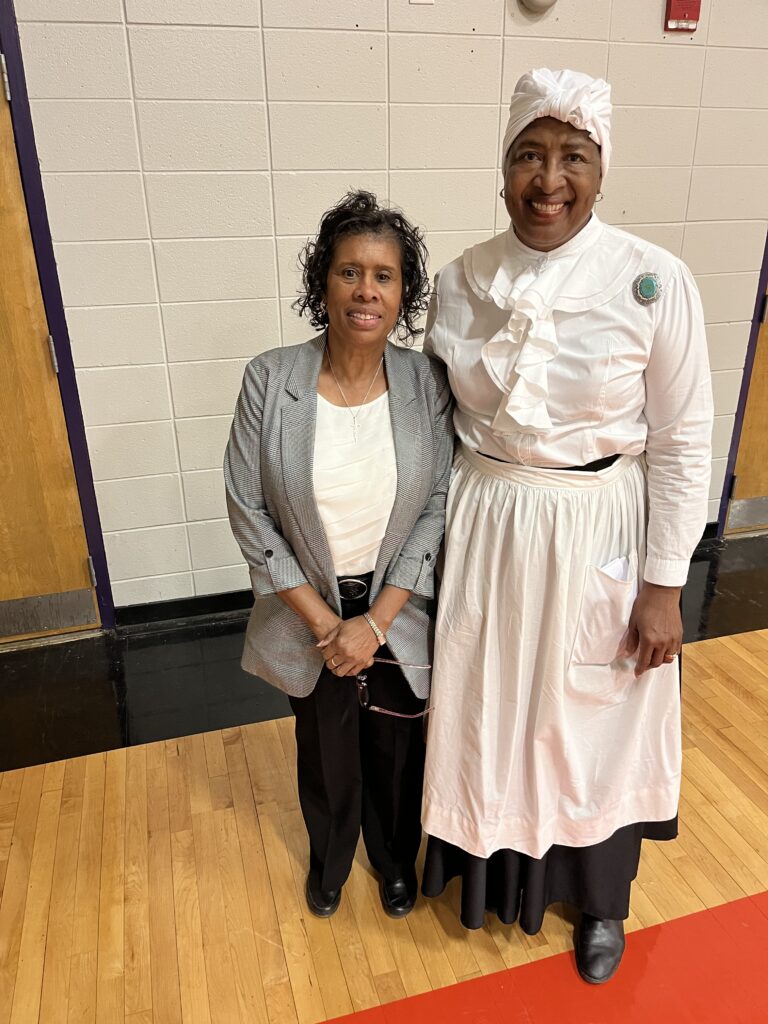
Towns consider it “a passion to tell her story.” Her aunt Effie Pearson was born in 1900, and lived through a century until she died in 2000, and was the family historian. Towns became fascinated by the stories and oral history passed down to her by her aunt.
Towns soon came to realize that there were “holes” in the stories and that there were events that happened before and after to precipitate the outcome. She also realized that “each story is like a quilt piece,” and all pieces must be fitted together to make a whole.
At “The Hill” celebration Towns chose to depict the life of Delia Logwood, a “free woman of color” who was one of Courtland’s first prominent citizens. Towns was dressed in period clothing to portray Logwood. Logwood was born to the daughter of a slave and her master, a wealthy white planter and lawyer, Matthew Clay from Virginia.
Clay was the father of three “mixed race” girls around eight years of age at the time of his death in 1815. He left instructions that the girls were to be emancipated and taken from the state of Virginia. They were to be clothed, boarded, and schooled until they were eighteen years of age. Logwood was emancipated in 1825.
Towns said that in Logwood’s account when she turned eighteen years of age, she was given five hundred dollars and a good suit of clothing. Logwood finally settled in Courtland, AL, and with the money given to her from her father’s estate, she purchased land in Courtland.
While Logwood was still a slave the first railroad and steam engine came through Courtland, AL. It was written that Logwood said, “a steam engine, imagine that.”
Towns gave an account of Logwood’s plight during the Civil War. Logwood was loyal to the Union, but suffered at the hands of both the Union and the Confederate soldiers. During the Civil War that was fought on her property, she suffered a great loss which included cattle, crops, chickens, and hogs. They ransacked her corn fields for food and slaughtered the livestock.
In January 1863, President Abraham Lincoln freed the slaves, but only those that were in a rebellious Southern state.
Logwood married Daniel Logwood when she was 21 years old, and she had previously purchased his freedom. They were the parents of seven children. She bought his freedom in 1865 for $535.00 from her inheritance left to her by her white father and master. Someone asked Logwood if he was worth it, and she said, “got seven children.” She also purchased lot #34-#35 and part of #36 in Courtland, AL in 1834, which is near the Courtland Town Hall. She also purchased lot #119.
The Winter of 1864 was, “hard cold” and 1500 White 5000 Black soldiers marched on her land. She had 30 acres of land, and they took the lumber and for four months they lived on her property and built shanties.
Logwood was fearful for the life of her family and sent her son to Decatur, AL to the Provost Marshall’s office to ask for protection. Soldiers were sent to protect her and her family, and her house were spared. The war ended in 1865.
“Colored men could marry and protect their families, men were granted the right to vote, and many wanted to learn to read.” Logwood died in March 1893 and is buried in Greenwood Cemetery in Birmingham, AL. Of her descendants, two became doctors and one a minister in New Haven, CT, and a Yale graduate.
Forty-one years ago, “The Hill” became known as North Courtland. Some of the descendants of former slaves and slave owners still reside in North Courtland and Courtland.
Towns’ challenge to everyone was to repeat three times, “Let nothing get in your way.” This was the saying of Richard Alexander Hubbard (R.A. Hubbard) for whom the school is named. He was a catalyst for education in the Black community who worked in education for forty-three years.