
This is an Opinion Piece
According to the National Oceanic and Atmospheric Administration (NOAA), it is very likely that 2021 will rank as one of the warmest years on record.
“The average global land and ocean surface temperature in August was 1.62 degrees F (0.90 of a degree C) above the 20th-century average of 60.1 degrees F (15.6 degrees C), making it the sixth-hottest August in the 142-year record,” according to NOAA data.
The months of June, July, and August of 2021 had temperatures that tied with the infamous “Dust Bowl Summer” of 1936, when the heat dried out much of the Midwest and led to severe dust storms and drought. According to NOAA, more than 18% of the contiguous US reached record high temperatures this summer. 2021 was within the top five hottest summers on record for 21 states.
Thankfully for us, Alabama was not among those 21 states, and received fairly average summer temperatures. Alabama did not experience any severe drought and only minor heat waves in July.
This does not, however, mean we should not be concerned for the rest of the country, and the world at large. The BBC reports that the number of days that reach over 50 degrees Celsius (122 degrees Fahrenheit) has doubled over the last 20 years. These are dangerous temperatures that can hospitalize and even kill people.
From the BBC:
“The increase can be 100% attributed to the burning of fossil fuels,” says Dr Friederike Otto, associate director of the Environmental Change Institute at the University of Oxford.
Increased carbon emissions over the last two decades has unequivocally altered the world’s environment. Not only in temperature extremes, but in the severity of the worlds weather as well.
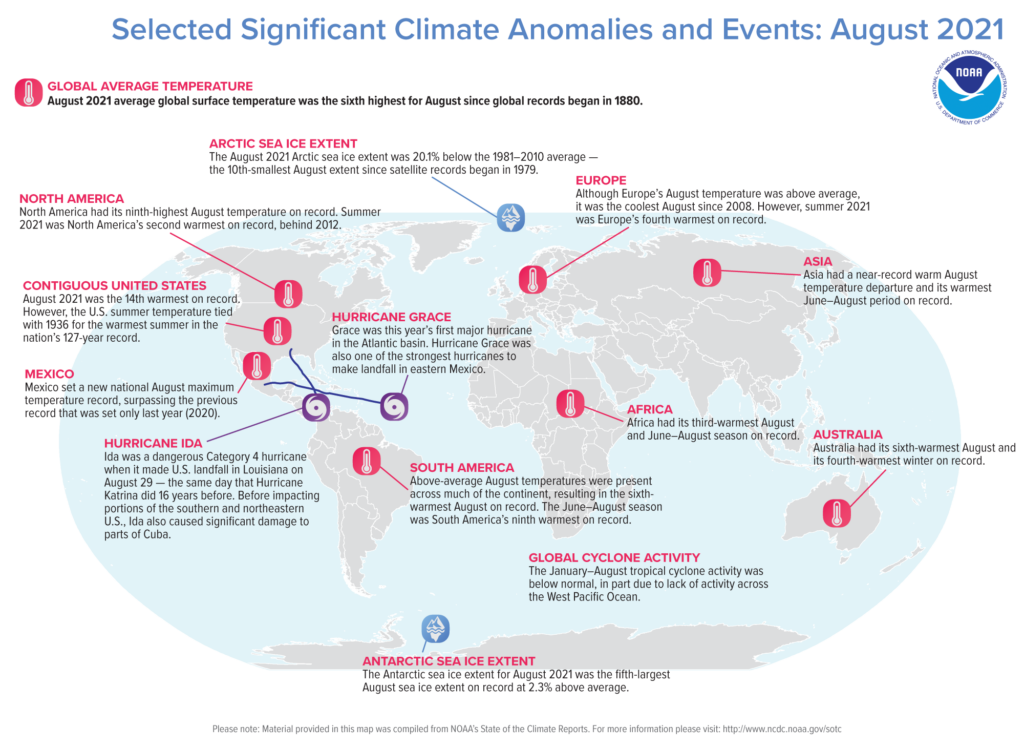
The recent hurricane Ida, and the flooding caused by it, has done catastrophic damage to southern Louisiana and states all the way to the east coast. The 2020 hurricane season had a total of 30 tropical storms, a record high, 14 of which developed into hurricanes. Seven of these hurricanes are considered major, (above Category 3 on the Saffir-Simpson Scale), which is another record high.
The extreme weather and temperatures are likely to only get worse as carbon emissions increase.
As said by Dr Sihan Li, a climate researcher at the School of Geography and the Environment at the University of Oxford:
“With continued emissions and lack of action, not only will these extreme heat events become more severe and more frequent, but emergency response and recovery will become more challenging.”