
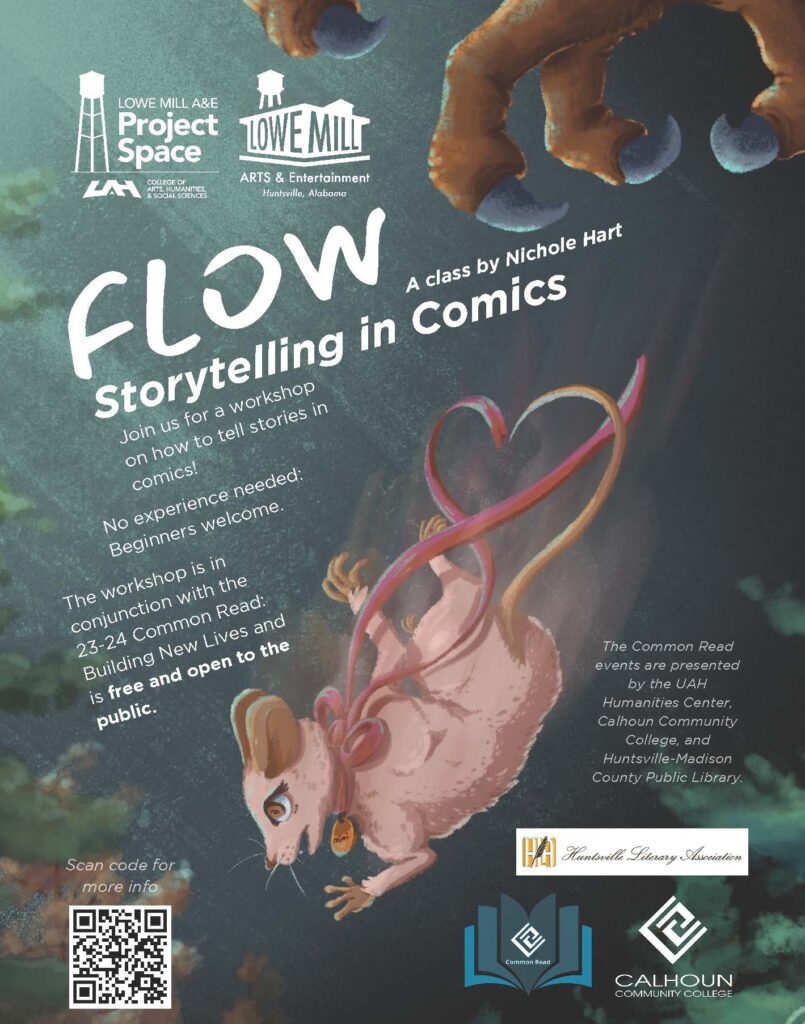
Lowe Mill hosted a workshop titled “Flow: Storytelling in Comics” with UAH lecturer Nichole Hart on Saturday, November 11. All ages and skill levels were welcome, and the primary goal was to learn about the process of developing comics in the professional world. The exercise was writing and illustrating a brief story from our own lives, inspired by the Common Read book, Thi Bui’s The Best We Could Do.
The lesson was broken down into the following steps:
Writing: Writing down what the comic is supposed to be about, outlining the atmosphere and feel of the story, and making note of visual details in the environment. This stage is meant to be short but concise, only containing what is needed to make the comic rather than being a standalone descriptive paragraph.
Editing: Editing the above writing to make sure it’s accurate to what the comic needs to be and trimming out any and all unnecessary fluff.
Thumbnail sketches: Thumbnail sketches are tiny, rough sketches meant to convey the bare bones of a panel or page layout. The point is not to create a starter sketch to build off of later, but rather to experiment with compositions and ideas before committing to a detailed sketch. Most thumbnail sketches only contain stick figures, and some are incomprehensible to anyone besides the artist who made them.
Reviewing and editing thumbnail sketches: This was the final stage that the workshop had time to cover, but not the final stage to creating a comic. During this stage, speech bubbles for dialogue are usually added to see how they impact the composition, and the final composition for pages and layouts is decided upon.
Rough sketches: Basic sketches based off the thumbnails, used as the jumping-off point for the rest of the sketching process. During this stage, many comics artists choose to hand-letter their text bubbles instead of using a computer font.
Pencils: The final sketch, with clean lines and fully rendered details. This is essentially the finished product. The inking stage should be about tracing the pencils, not continuing to add new elements to the drawing.
Inking/Coloring: The final stage of comics production. It can take many forms, from traditional dip pens to ballpoints to even digital painting programs. Pages are colored as single compositions, rather than going from panel to panel. All effects such as sound effects and speech bubbles are finalized and polished.
The hour was enjoyed by all who were in attendance, ranging from college students to parents and their children. Even those with little to no interest in comics were having fun by the time the session concluded.